


 cn
cn English
Product Consultation
Your email address will not be published. Required fields are marked *
Content
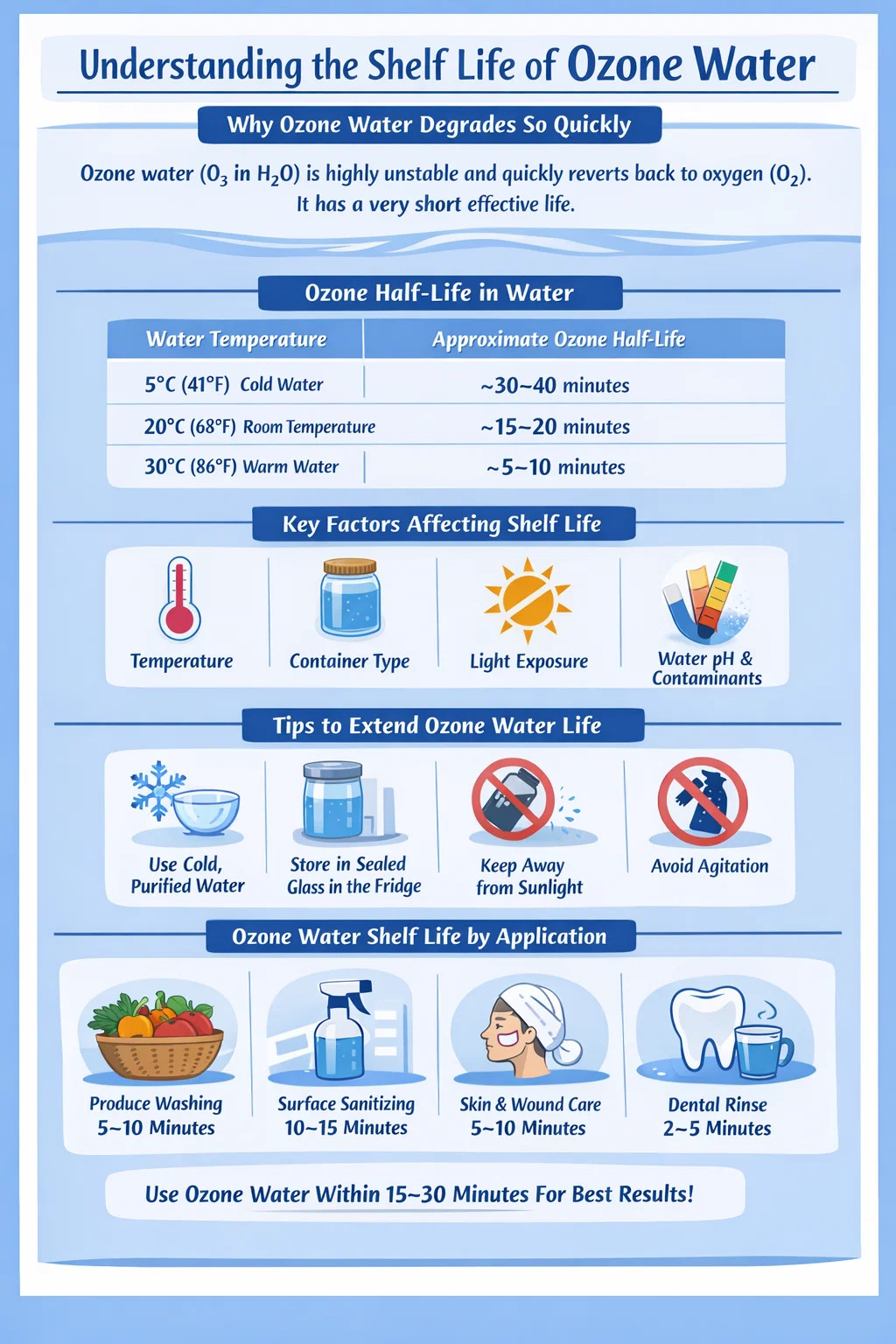
Ozone water does not last long. Under typical conditions, ozonated water loses most of its active ozone within 15 to 30 minutes at room temperature. In some cases, especially in warm or exposed environments, the ozone concentration can drop to near zero in as little as 10 minutes. This is not a flaw — it is simply the chemical nature of ozone (O₃), a highly unstable molecule that rapidly reverts to ordinary oxygen (O₂).
If you are using ozone water for sanitizing surfaces, washing produce, treating skin conditions, or any other application that depends on its oxidizing power, you need to use it immediately after generation. Storing it and hoping it will remain effective hours later is not realistic without very specific conditions.
That said, the actual shelf life depends on several variables: temperature, light exposure, container type, initial ozone concentration, and whether the water is still or agitated. Understanding these factors helps you get the most out of every batch of ozone water you produce.
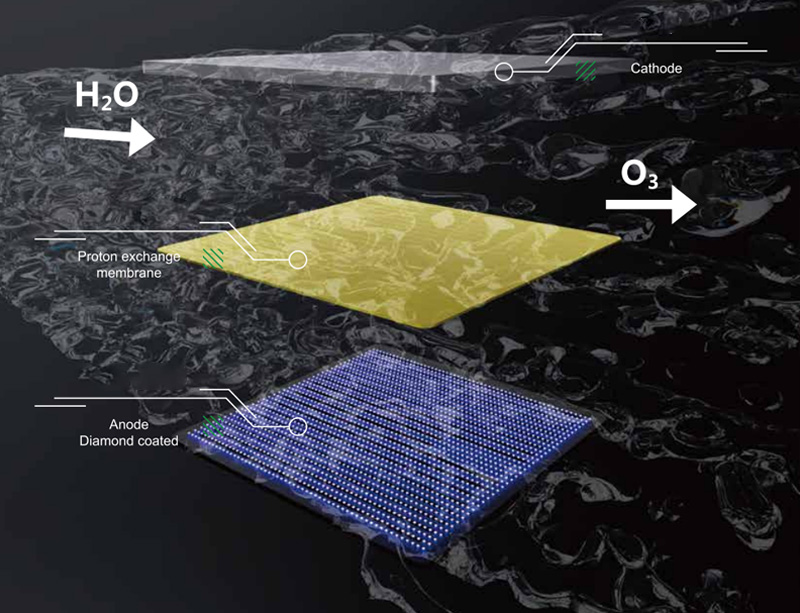
Ozone water, sometimes called ozonated water, is simply water into which ozone gas (O₃) has been dissolved. Ozone is generated either by ultraviolet light or by corona discharge, and then bubbled through water until it reaches a measurable concentration — typically between 0.1 mg/L and 4 mg/L for consumer and commercial applications.
The reason ozone water degrades so fast comes down to the instability of the O₃ molecule itself. Ozone is a triatomic form of oxygen with a half-life that varies significantly by environment. In water, it undergoes a process called decomposition — it breaks apart into oxygen radicals and eventually into regular O₂. This decomposition is accelerated by heat, organic matter, alkaline pH, and light.
Unlike chlorine or hydrogen peroxide, which can persist in water for hours or days, ozone is among the fastest-degrading disinfectants available. This is actually considered one of its advantages in food safety and environmental applications — it leaves no chemical residue — but it also means that timing is everything when you use it.
| Water Temperature | Approximate Ozone Half-Life | Practical Implication |
|---|---|---|
| 5°C (41°F) — Cold Water | ~30–40 minutes | Best for extended use; refrigeration helps preserve potency |
| 15°C (59°F) — Cool Water | ~20–25 minutes | Moderate window; use within 20 minutes |
| 20°C (68°F) — Room Temperature | ~15–20 minutes | Standard indoor conditions; use quickly |
| 30°C (86°F) — Warm Water | ~5–10 minutes | Degrades very fast; not suitable for storage |
| 40°C+ (104°F+) — Hot Water | <5 minutes | Nearly immediate loss; ozone is ineffective at high heat |
There is no single expiration timestamp that applies to all ozone water equally. The effective life of your ozonated water depends on the interplay of multiple environmental and chemical conditions. Here is a breakdown of the most important ones.
Temperature is the single most influential factor. Cold water holds ozone much longer than warm water. Refrigerated ozone water at around 4°C to 5°C can retain measurable ozone activity for up to 30 to 45 minutes, and in tightly sealed glass containers some residual ozone may persist slightly longer. At room temperature (20°C to 22°C), you are typically working with a 15 to 20 minute window before significant degradation occurs. At 35°C or above, ozone water essentially becomes useless within minutes.
Ozone reacts with many materials, including certain plastics. Standard plastic bottles made from PET or polycarbonate can accelerate ozone degradation because ozone oxidizes trace organic compounds in or on the plastic surface. Glass containers are significantly better for storing ozone water, as glass is chemically inert and does not react with ozone. Stainless steel is also acceptable, but only food-grade, non-reactive grades. A tightly sealed container also prevents ozone from off-gassing into the surrounding air, which helps preserve concentration slightly longer.
Ultraviolet light, particularly sunlight, speeds up ozone decomposition in water. If you leave a clear glass of ozone water on a sunny countertop, you will lose ozone activity faster than if you store it in a dark cabinet. Amber glass bottles used in laboratory and pharmaceutical settings are effective at blocking UV and can meaningfully extend the shelf life of ozone water when combined with refrigeration.
Ozone is more stable in slightly acidic water and degrades faster in alkaline water. At a pH of 7 (neutral), decomposition occurs at a moderate rate. At a pH above 8, decomposition accelerates significantly because hydroxide ions (OH⁻) catalyze the chain-reaction breakdown of ozone. If your tap water is alkaline — common in many parts of the world — your ozone water will degrade faster than someone using slightly acidic or purified water.
Ozone reacts readily with organic compounds. If your water already contains dissolved organics — from tap water impurities, food residue, or other contaminants — ozone will be consumed reacting with those substances rather than remaining in solution. This is why distilled or reverse-osmosis-purified water holds ozone longer than ordinary tap water. The cleaner the base water, the longer the ozone remains active.
Higher starting concentrations mean more ozone is available before full degradation. A batch of ozone water generated at 2 mg/L will remain above a functional disinfection threshold for longer than a batch generated at only 0.3 mg/L, even if both degrade at the same rate. Industrial ozone systems used in food processing often operate at concentrations of 1 to 4 mg/L precisely to allow a longer working window.
While no storage method will make ozone water last for days, there are practical steps you can take to extend its effective window from a few minutes to 30 minutes or more. These practices are especially useful when you are generating ozone water in batches for use over the course of a cleaning session or a meal-prep routine.
Even with all of these measures in place, it is best practice to plan to use your ozone water within 30 minutes of generation. Anything beyond that should be treated as potentially depleted, especially if you are relying on it for sanitation or disinfection purposes where efficacy is critical.
The urgency of using ozone water immediately versus within a short window varies depending on what you are using it for. Some applications are more forgiving than others. Here is how shelf life considerations play out across common uses of ozone water.
Ozone water is widely used in commercial food processing to wash fruits, vegetables, and meat. The U.S. FDA approved ozone as a direct food contact substance in 2001. For produce washing, the water needs to be at or above an effective ozone concentration — typically 0.5 to 2 mg/L — at the point of contact. This means you should wash produce within 5 to 10 minutes of generating the ozone water, especially at room temperature. Waiting 30 minutes or more risks using water that is functionally just regular water.
For spraying countertops, cutting boards, or sinks, you need active ozone at the moment of application. Generating ozone water in a spray bottle and using it within 10 to 15 minutes is the standard recommendation. Some commercial ozone spray systems generate ozone directly in the nozzle during spraying to eliminate any shelf life issue entirely — this is the most effective approach for surface sanitation.
Some dermatological and alternative medicine applications involve applying ozone water to skin for its antimicrobial and anti-inflammatory properties. For topical use, the water should be applied as fresh as possible — ideally within 5 to 10 minutes of generation. Using ozone water that has been sitting for an hour on a wound or skin condition provides no ozone benefit; it is simply water at that point.
Ozone water is used in some dental practices as a rinse for its antibacterial properties. Because mouth temperature is around 37°C, ozone degrades very rapidly once it enters the oral environment. Oral rinses with ozone water are most effective when the water is generated and used within 2 to 5 minutes, and the rinsing itself should be done promptly after generation.
The question of drinking ozone water for potential health benefits is separate from its sanitation applications. While some proponents suggest health benefits from drinking freshly ozonated water, it is important to note that ozone at high concentrations can irritate mucous membranes and the digestive tract. For drinking, ozone concentrations should be well below 0.4 mg/L — the WHO guideline for ozone in drinking water — and the water should be allowed to off-gas slightly so concentrations are safe. From a shelf life perspective, drinking ozone water that has been sitting for 20 to 30 minutes is actually safer than drinking very freshly generated water with a high ozone concentration.
Cold-water ozone laundry systems inject ozone directly into the wash cycle. Because the treatment happens continuously during the cycle, shelf life is not a concern here. However, if you are manually adding ozone water to a soak, the same rules apply — use it within 10 to 15 minutes for meaningful benefit.
There is a fair amount of misinformation circulating about ozone water, particularly from product marketing that overstates how long ozonated water remains effective. Here are some of the most common misconceptions worth addressing directly.
Some marketing materials for consumer ozone generators suggest their products create ozone water that remains effective for "several hours." This is not accurate under normal conditions. At room temperature in a typical unsealed container, ozone water loses most of its active ozone within 15 to 30 minutes. The only scenario where ozone water might retain meaningful concentration beyond one hour is in a sealed glass container stored at near-freezing temperatures with a very high initial ozone dose — conditions not typical in a home setting.
Refrigeration helps slow ozone degradation, but it does not stop it. Ozone water stored in a refrigerator overnight will have essentially zero ozone remaining by morning. It will not be harmful to use — it simply becomes regular water. If you plan to refrigerate a batch, use it within 30 to 45 minutes for best results, not the next day.
The distinctive sharp, clean smell of ozone can linger even after the dissolved ozone has substantially degraded. This is because the smell comes from trace amounts of ozone in the vapor above the water surface, not necessarily from high dissolved ozone in the liquid. Do not use smell alone as an indicator of potency — it can be misleading.
Unlike bleach solutions or quaternary ammonium compounds that can be made in large batches and used over days or weeks, ozone water must be freshly generated for each use session. It is a point-of-use technology. Trying to batch-produce and stockpile ozone water for disinfection purposes defeats its core mechanism.
Without a dissolved ozone meter — an ORP (oxidation-reduction potential) meter or a colorimetric ozone test kit — it is difficult to know with certainty whether your ozone water still has active ozone in it. However, there are practical indicators you can rely on.
For applications where ozone efficacy is critical — food safety, wound care, or sanitation — investing in an ORP meter (available for around $20 to $80) is worthwhile. It removes all guesswork and lets you confirm you are working with active ozone water before use.
Understanding how ozone water shelf life compares to other common sanitizing agents helps clarify why ozone water requires immediate use while other disinfectants allow more flexibility.
| Disinfectant | Shelf Life After Preparation | Residue Left | Suitable for Food Contact |
|---|---|---|---|
| Ozone water | 15–30 min (room temp) | None | Yes (FDA approved) |
| Bleach solution (100–200 ppm) | 24 hours (diluted) | Chlorine residue | Limited; requires rinsing |
| Hydrogen peroxide (3%) | Several days if stored properly | Water and oxygen only | Limited at high concentrations |
| Quaternary ammonium (quat) solution | Up to 30 days | Chemical film residue | Not recommended for direct food contact |
| Isopropyl alcohol (70%) | Months to years (sealed) | Evaporates; no residue | Not suitable |
The trade-off with ozone water is clear: it degrades faster than almost any other disinfectant, but it also leaves zero chemical residue, requires no rinsing, and is fully approved for direct food contact. For those willing to work within its time constraints, it offers a uniquely clean sanitation option.
If you own or are considering a home ozone water generator, these practical habits will help you use it effectively without wasting ozone or relying on depleted water.
Ozone water is a powerful, residue-free sanitizing agent with a well-documented track record in food safety, water treatment, and surface disinfection. But its effectiveness is entirely time-dependent. At room temperature, you have approximately 15 to 30 minutes of meaningful ozone activity after generation. Refrigerated in a sealed glass container, that window can stretch to 30 to 45 minutes. Beyond that, you are working with ordinary water.
The best strategy for anyone using ozone water consistently is to treat it as a fresh-use-only resource: generate it, use it within the window, and generate again for the next task. This approach aligns with how ozone water functions chemically and ensures you are always getting the full antimicrobial benefit it can provide.
For applications where timing is critical — food safety, wound care, or dental use — an ORP meter removes all uncertainty and gives you a real-time reading of whether your ozone water is still performing. For general household use, a disciplined habit of generate-and-use-immediately is sufficient and requires no additional equipment.
Understanding and respecting the shelf life of ozone water is not a limitation to work around — it is the key to using ozonated water correctly and getting consistent, reliable results every time.
Is ozone water the same as reverse osmosis water?
2026-03-09
Is It Healthy to Drink Ozonated Water? What You Should Know
2026-03-23Your email address will not be published. Required fields are marked *
Protecting the oral cavity
Preventing bad breath
Oral recovery
Sterilization and disinfection

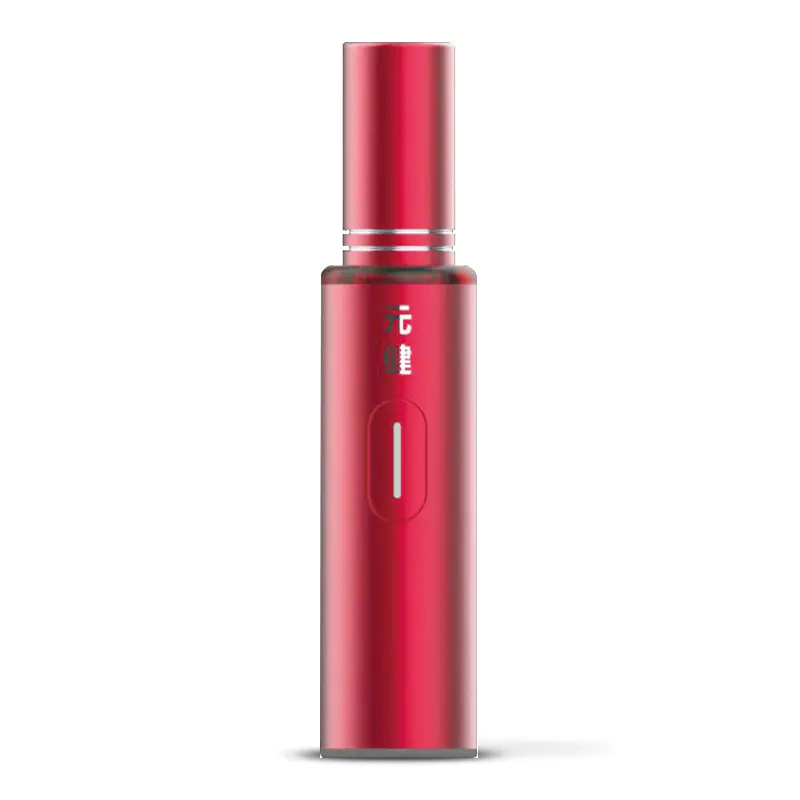
Smooth and clean face
Safe makeup removal
Suitable for sensitive skin
Activate cell activity

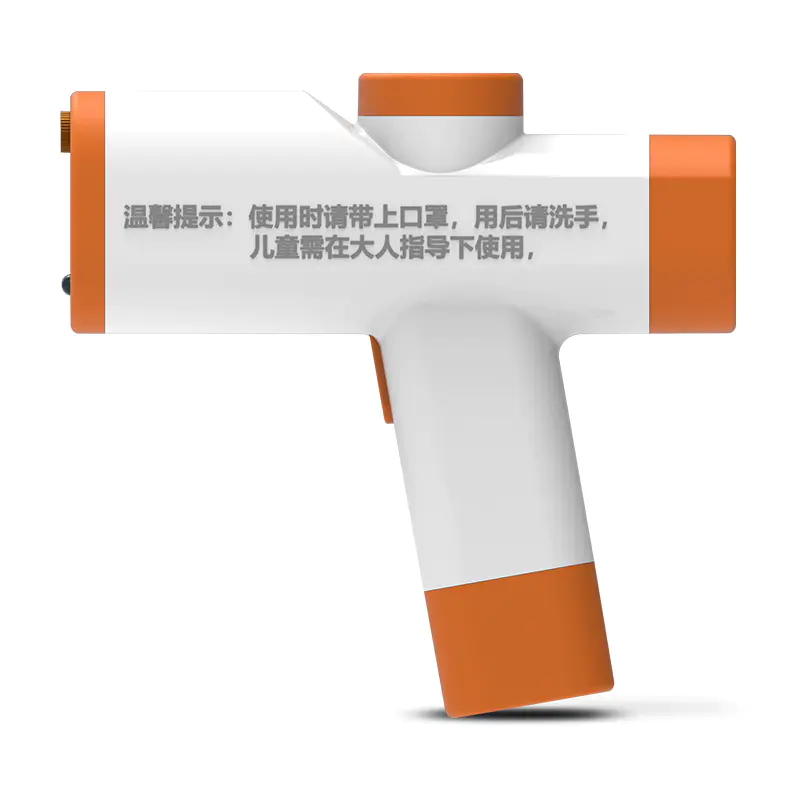
Sterilization
Disinfect
Sterilization
Disinfect

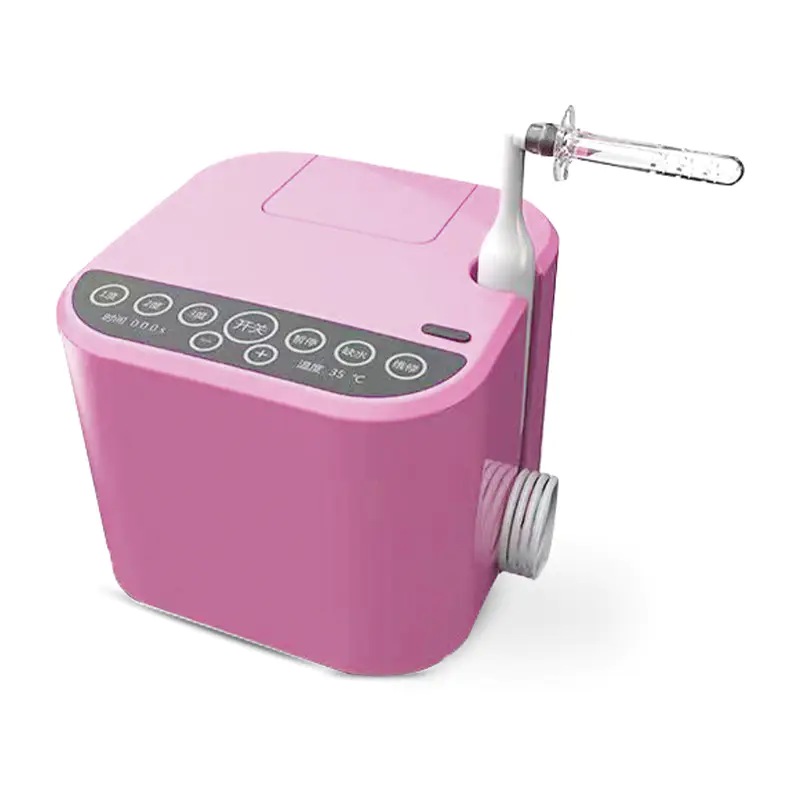
Sterilization and anti-inflammatory
Remove odors
Wound repair
Solve itching

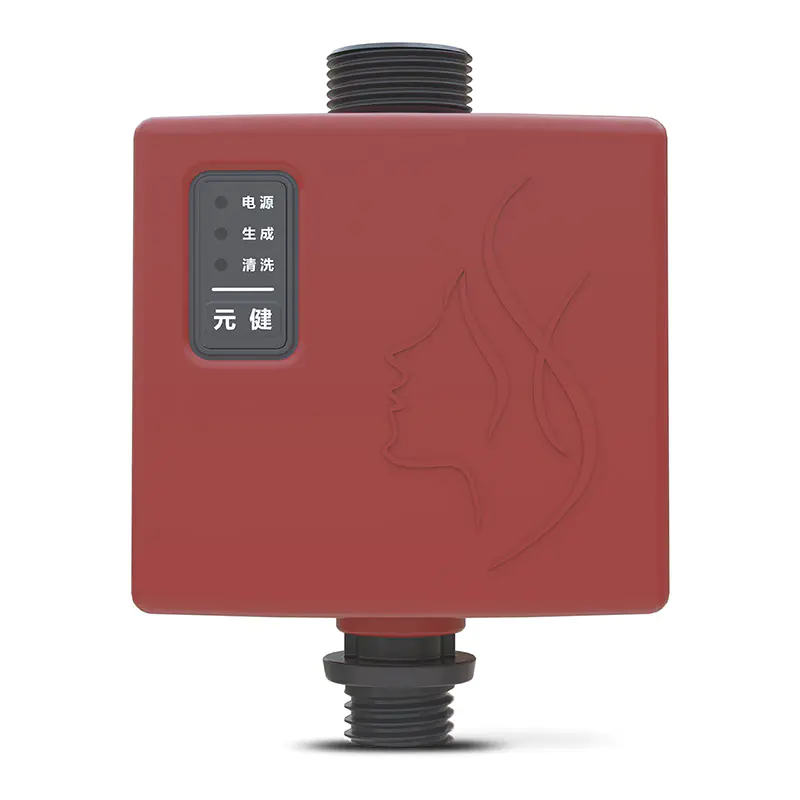
Fix pore issues
Solve itching
Smell remover
Degreasing
Pale yellow gas
Acne care
Suitable for sensitive muscles
Shorter cycle
Natural flexibility
Effectively decompose oil stains
More Whiter
Extending the lifespan of clothing
Reduce ecological pollution

Fruit and vegetable cleaning
Meat cleaning
Grain cleaning
Tableware disinfection
Preservation
Deodorization

Smell remover
Preventing and alleviating skin diseases
sterilization

If you are interested in our products, please consult us
Copyright © 2023 Ningbo Hengqi Health Technology Co, Ltd. All Rights Reserved wholesale Ozone Water Sprayer Equipment Manufacturers OEM/ODM Ozone Water Purifier Factory